The long life
of a deck
of cards.
Playing-card history through the pictures: Italian knights, familiar Queens, the printers who made them, and the games they’ve come to play.
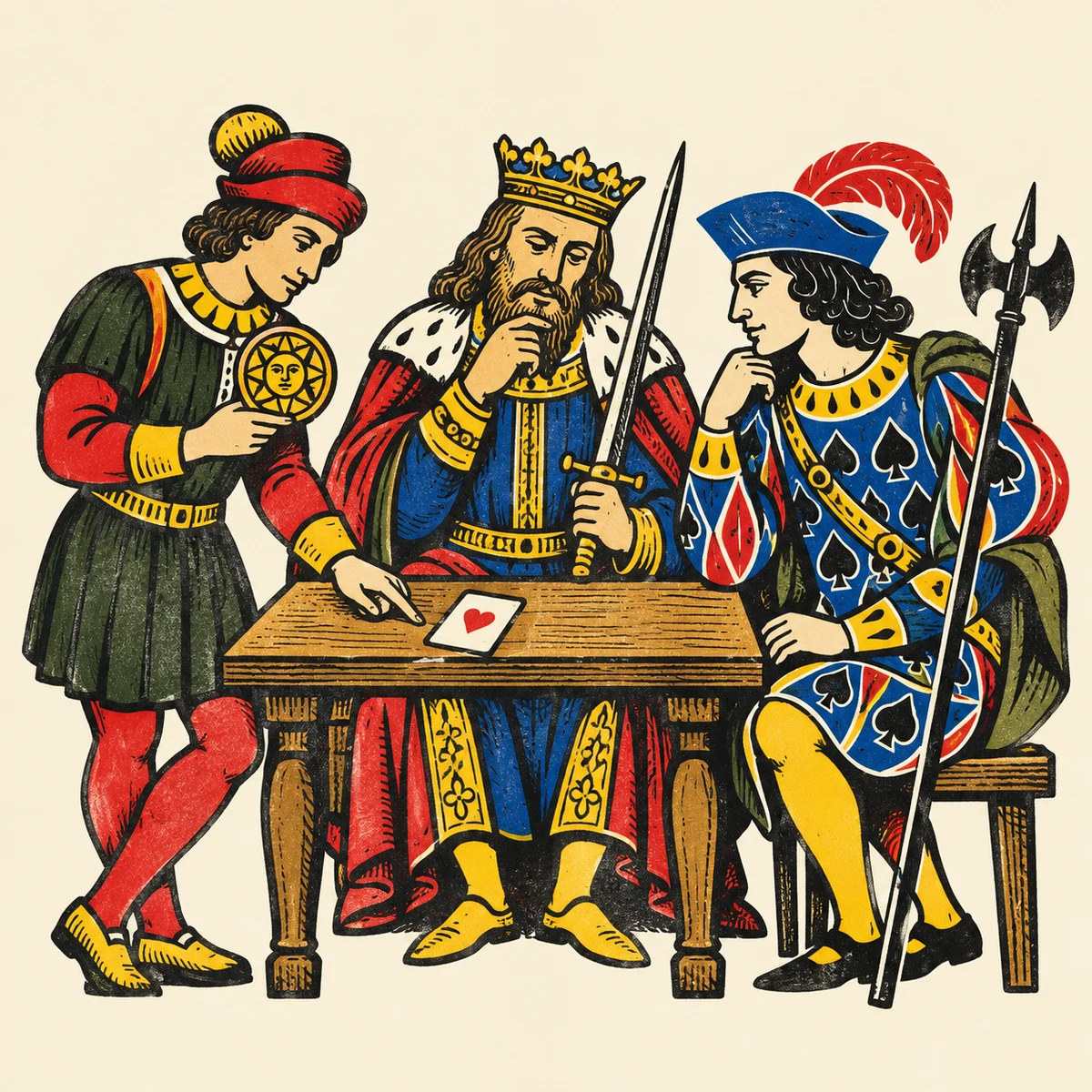
Different cards, one table.
Put a Napoletane knight next to a familiar Queen. They occupy the same place between the lowest court and the King, but one arrives on horseback.
Then look at a Triestine Ace, with its ornament and little saying. Or the enormous spade on a standard Ace. A deck carries a surprising amount of history for something that fits in a pocket.
This collection follows a few of those histories: the pictures that became familiar, the games people played with them, and the makers who kept printing them. It also follows a much newer game, Superjack, which grew from a love of Magic: The Gathering and a desire to make a battle game with ordinary playing cards.
A few distinctions before the timeline
Napoletane and Triestine are deck patterns. Briscola is a game. Modiano is a manufacturer. You can play Briscola with either regional deck, and buy different patterns from the same maker. Each deserves its own story.
The timeline brings them together by date. It follows selected milestones, rather than claiming every deck or game descends directly from the one before it. “By” means a pattern was already present; “around” marks an approximate date.
From early packs to new games
- 1370s
Playing cards spread through Europe
Written records begin to cluster across European cities. Latin suits echo the cups, coins, swords, and polo sticks found on Mamluk cards.
IPCS · Early playing cards - Around 1480
French suits take shape
Hearts, diamonds, clubs, and spades offer cardmakers simpler symbols to print and color.
World of Playing Cards · French suits - By 1480
Rouen cards travel to Britain
Exports from Rouen are part of the ancestry of the familiar English-pattern courts.
IPCS · English pattern - Late 1700s
Napoletane examples survive
The Neapolitan pattern is documented in surviving packs, with Spanish influences in its figures.
World of Playing Cards · Napoletane - 1828
Briscola appears in the record
An early reference gives the game a documented place in the nineteenth century. Its exact origins remain uncertain.
Italian Wikipedia · Historical references - By about 1850
Triestine becomes distinct
Trieste’s cardmakers develop a distinct version of Venetian cards, including labels naming the courts.
IPCS · Triestine pattern - By about 1860
English courts turn both ways
Double-ended courts become established: familiar figures can be read either way up.
IPCS · English pattern - 1868
Modiano begins in Trieste
Saul D. Modiano establishes his company, initially trading in cigarette papers. Playing cards become part of its later story.
Modiano · Company history - 1993
Magic: The Gathering arrives
Richard Garfield’s game becomes a later inspiration for Superjack’s creators.
Wizards of the Coast · Magic timeline - Around 1999
A friend introduces Magic
CJ shows a future Superjack co-creator his cards during a visit to West Allis, Wisconsin. School games in Palm Springs follow.
The co-creator’s account - Years later
Superjack takes shape
Two friends begin making a battle game with ordinary cards. Years of tests lead to the forty-card game.
The co-creator’s account
Choose a deck, follow its story
The deck guides include photographs or illustrations, details worth looking for, and the card translations needed to play Superjack. Briscola gets its own introduction to the game. The Superjack page connects its development to the people who made it.
Why this matters to a Magic player
You can love a card before you understand what it does. That was true of the Magic cards in our founder’s story, and it’s a good reason to look closely at a traditional deck. The standing knave, mounted knight, and named courtier all offer something different from the cards you already know.
Superjack gives those cards another game to play. Each player starts with the same forty-card contents, then draws different hands and makes different decisions. Magic’s creature battles, poker’s patterns and luck, and chess’s equal starting tools all helped shape it.
Start with the deck that catches your eye. Its own history is worth the read; the Superjack guide at the end gives you something to do with it afterward.