Napoletane
cards,
up close.
The history and artwork of the Neapolitan forty-card deck, the games it plays, and a simple guide to using it for Superjack.
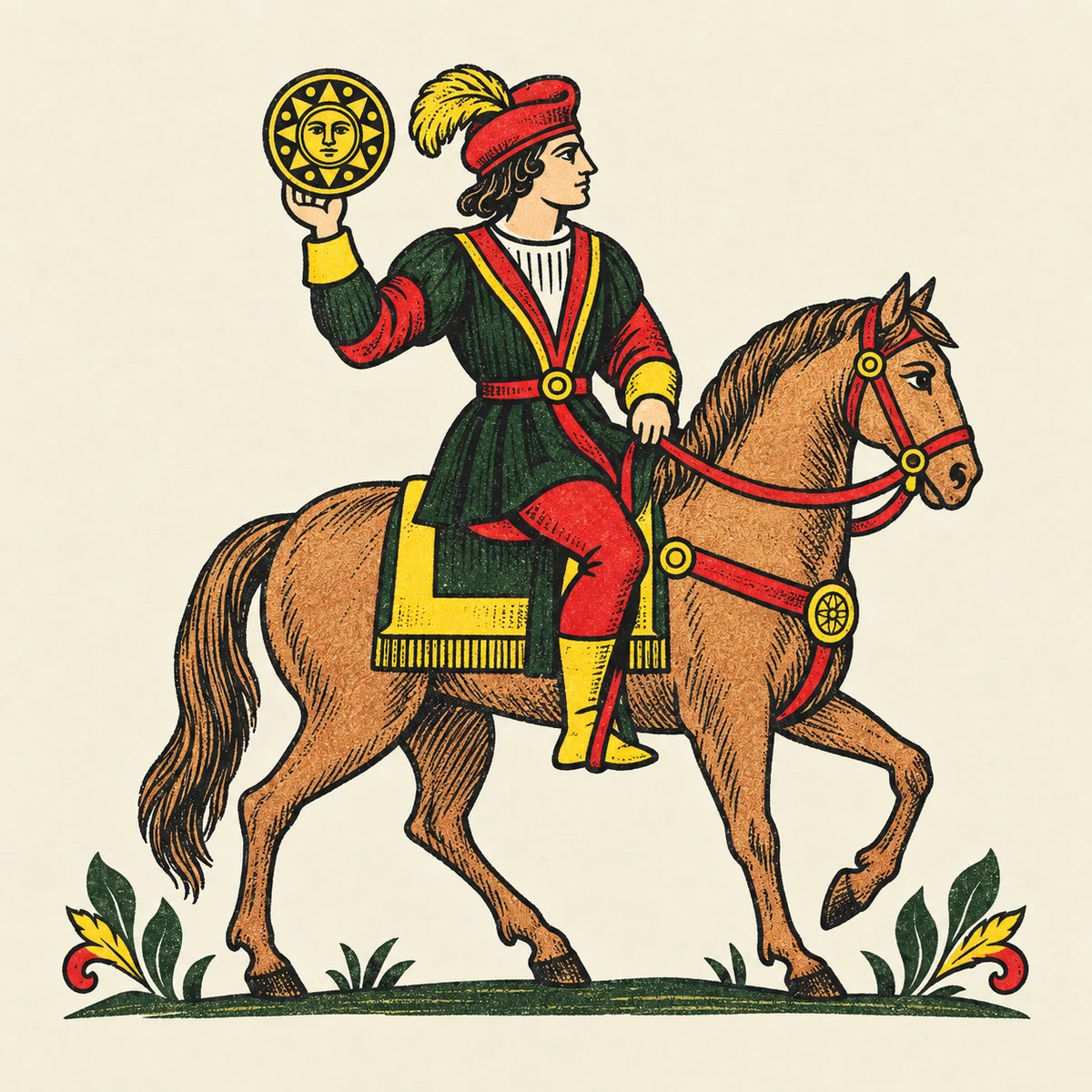
The knight of coins takes a ride.
Look between the three batons. There’s a face looking back.
It’s one of the small pleasures of Napoletane cards: familiar objects become strange when you actually stop to look at them. An eagle carries two heads. Coins have faces. A knight holds a cup while his horse lifts a hoof. Even the number cards have something going on.
Napoletane names the card pattern associated with Naples. It’s a deck for several games, including Briscola, Scopa, and Tressette. Its forty cards also translate neatly into Superjack, the creature battle game that began with a question about playing Magic: The Gathering using ordinary cards.
A deck with Spanish roots
The Neapolitan pattern belongs to the Spanish-suited tradition: cups, coins, swords, and clubs. Its figures have Spanish antecedents, and surviving examples are known from the late eighteenth century. The World of Playing Cards’ history traces those connections without assigning the whole pattern to one inventor.
The customary courts are single figures shown from head to foot. In the example below, you can see their shoes and the little platforms under them. The swords are straight; the batons look like stout pieces of wood. Compare them with the interlaced curves in a Triestine deck and the regional difference becomes obvious.

Three details to look for
The Ace of Coins has a double-headed eagle surrounding a large circular space. In older packs, tax markings could occupy space on this card. The Three of Batons puts a face at the meeting of its clubs. The courts give you three different figures: a standing knave, a mounted knight, and a crowned king. The documented examples show how these motifs persist across editions.
If you love Magic’s illustrations, there’s a familiar pleasure here: recognizing a card before you’ve read anything on it. With this deck, learning the picture is often how you learn the card.
A short Napoletane timeline
- Earlier roots
Spanish-suited ancestry
The court figures preserve Spanish influences.
World of Playing Cards · Pattern history - Late 1700s
Napoletane examples survive
The Neapolitan pattern is documented in surviving packs, with Spanish influences in its figures.
World of Playing Cards · Napoletane - 2018
An anniversary edition
Modiano marks its own 150th anniversary with a Napoletane edition. The deck pattern is older than the company.
Modiano · Napoletane anniversary edition - Another game to play
Forty cards become Superjack
Keep the whole pack; translate the ranks and suits using the key below.
Superjack · Rules
What people play with them
Briscola uses trumps and point-bearing cards. In Scopa, a card from your hand captures an equal-valued card—or an eligible combination—from the table. Clearing the table earns a sweep, except on the final play. The same little pictures support very different decisions.
The common forty-card pack has an Ace, 2 through 7, and three courts in every suit. Dal Negro’s Napoletane Extra is one current example. Wikipedia’s overview of Italian playing cards places it among the other regional patterns.
Translate the deck into Superjack
Use one complete deck per player. Keep all forty cards, including every court. Both players should use this same mapping:
| Napoletane suit | Superjack suit | Color |
|---|---|---|
| Coppe · Cups | Hearts ♥ | Red |
| Denari · Coins | Diamonds ♦ | Red |
| Spade · Swords | Spades ♠ | Black |
| Bastoni · Batons | Clubs ♣ | Black |
The red and black groups are a convention for Superjack. Go by the suit, even if a black-group card is covered in red ink.
| Napoletane card | Superjack role |
|---|---|
| 2–7 | Gems, keeping their numbers |
| Fante · Knave | Jack: costs 2 energy, starts at 1/1 |
| Cavallo · Knight | Queen: costs 4 energy, starts at 2/2 |
| Re · King | King: costs 5 energy, starts at 3/3 |
| Asso · Ace | Ace: costs 3 energy; choose its mode |
All creature costs require energy of the creature’s mapped color. The two stat numbers are damage dealt and damage needed to kill the creature. Aces keep their normal creature and spell options.
For example, your four of cups and four of coins form a red pair. Tap both and equip one of your creatures with them for +1/+1. A three of swords, four of batons, and five of swords form a black straight. The gem guide explains how to use those combinations.
Start with twenty health and five cards each, then follow the full Superjack rules. You can leave the translation beside the table for your first game. The face in the Three of Batons will still be there when you turn it sideways.