The ordinary
deck took
centuries.
French suits, English court cards, and printers such as Modiano shaped the familiar pack. Here’s its history—and how to turn two standard decks into Superjack.
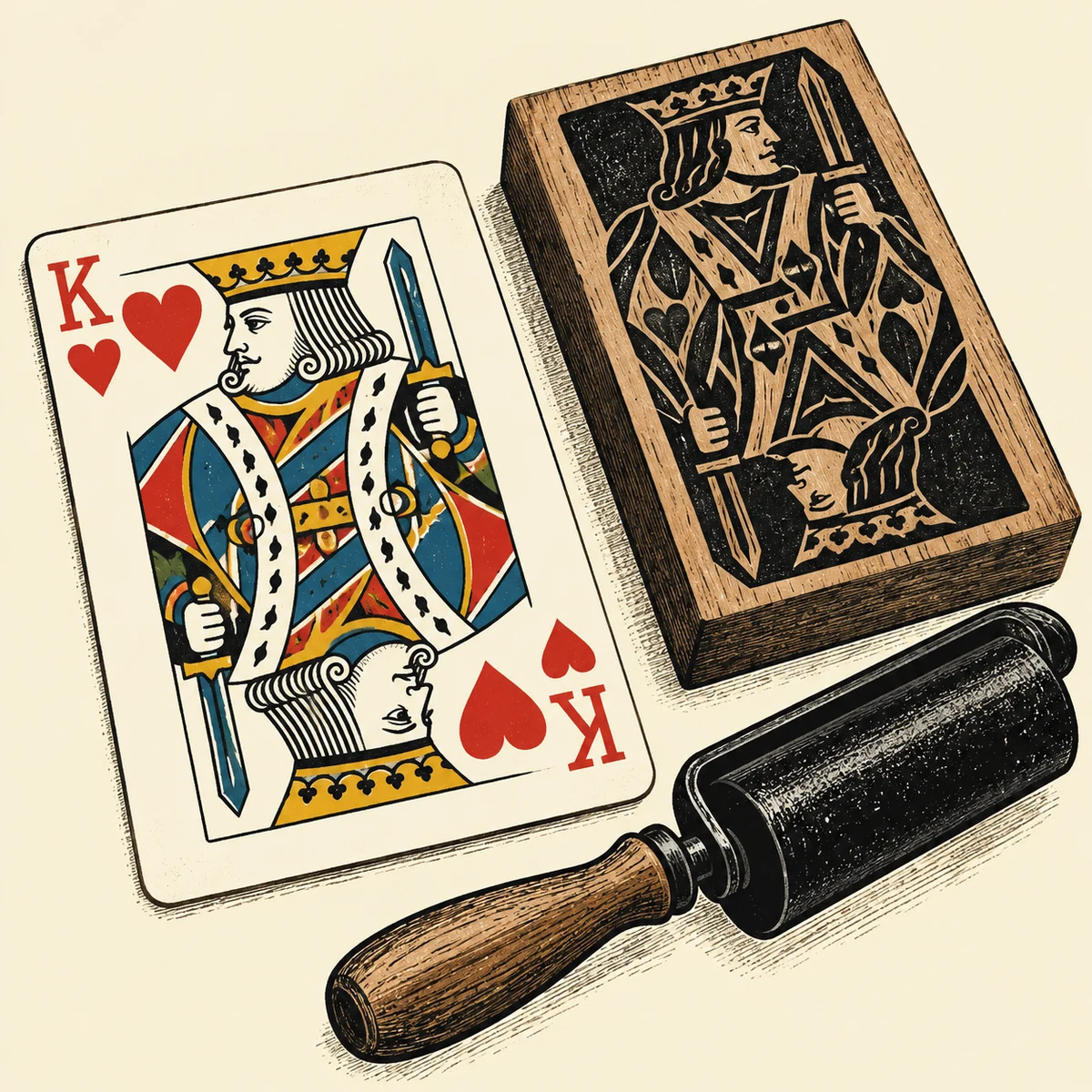
A familiar face, printed again.
You probably recognized the King before you noticed what he was holding.
That’s how familiar these cards have become. A crown, a red or black suit, a figure repeated upside down: you can read the card in a moment. Spend a little longer with it and the picture becomes harder to explain. What happened to his legs? Why are the clothes so geometric?
The ordinary deck has been through a great many printers’ hands.
French suits, English courts
The familiar hearts, diamonds, clubs, and spades are French suits. One particular arrangement of kings, queens, and jacks became the English pattern, also called the Anglo-American or international pattern. Other French-suited court designs exist, including those found on some Modiano packs. A suit system and a court design are two different things. Standard-deck overview.
Those four familiar shapes also made cards easier to manufacture. French makers could color them through stencils in red and black, with less work than more elaborate suit symbols. The early Anglo-French cards show a practical printing decision becoming part of the deck’s appearance.
The English pattern’s ancestors came from Rouen. Cardmakers there were exporting to the British Isles by 1480; London makers established themselves much later, toward the end of the sixteenth century. Over generations of copying and redrawing, the figures became more stylized. The International Playing-Card Society’s pattern sheet follows that development.
Why the King has two heads
Early courts had whole, upright figures. By about 1860, English-pattern courts had become double-ended. You could turn a card either way up and still have a King looking back. The clothes and objects had to fit the new layout; repeated copying had already altered many details. Court-card history.
Those odd shapes are part of the appeal. A court card is a tiny piece of graphic design you learn almost without trying. Give the Jack a job in a battle game and he looks surprisingly at home.
Where Modiano fits
Modiano is a cardmaker. Its range includes standard French-suited packs and regional decks such as Napoletane and Triestine. The name on the box identifies the maker; the cards inside tell you the pattern.
The company began in Trieste in 1868, trading in cigarette papers. It later expanded into printing and playing cards, including acquiring the La Concordia card factory. Its history also credits artist Pollione Sigon with designs for the Ramino 98 deck during the 1920–1930 period. That’s a useful reminder that even familiar commercial decks have artists behind them. Modiano’s own history.
A short timeline of the familiar deck
- Around 1480
French suits take shape
Hearts, diamonds, clubs, and spades offer cardmakers simpler symbols to print and color.
World of Playing Cards · French suits - By 1480
Rouen cards travel to Britain
Exports from Rouen are part of the ancestry of the familiar English-pattern courts.
IPCS · English pattern - Late 1500s
- By about 1860
English courts turn both ways
Double-ended courts become established: familiar figures can be read either way up.
IPCS · English pattern - 1868
Modiano begins in Trieste
Saul D. Modiano establishes his company, initially trading in cigarette papers. Playing cards become part of its later story.
Modiano · Company history - 1920–1930
An artist behind the pack
Pollione Sigon develops designs including Modiano’s Ramino 98.
Modiano · Company history
Fifty-two cards, many sets of rules
Four suits with thirteen ranks give you fifty-two cards. The Jokers are extras. Poker, bridge, and rummy ask different things of that same pack: combinations, tricks, or sets and sequences. The printed cards supply a common vocabulary; the game tells you what counts.
That’s also the appeal if you’ve ever searched for a game like Magic: The Gathering using standard playing cards. There are already characters, colors, numbers, and combinations to work with. Superjack began with that question, then developed its own creature combat, equipment, and responses.
Make two decks ready for Superjack
Give each player one standard deck. Set aside the Jokers and remove every 8, 9, and 10. Each player now has forty cards: 24 gems and 16 creatures.
| Cards | Their job in Superjack |
|---|---|
| 2 through 7 | Gems: make energy, equip creatures in pairs, form straights, or sacrifice for an ability |
| Jack | A 1/1 creature costing 2 energy; Jacks can stack |
| Queen | A 2/2 creature costing 4 energy |
| King | A 3/3 creature costing 5 energy |
| Ace | Costs 3 energy; can become a creature, destroy a gem, or cancel another Ace |
The two stat numbers mean damage dealt and damage needed to kill the creature. Hearts and diamonds are red; spades and clubs are black. Pay creature costs with energy of the same color.
Start with twenty health and five cards each. The first player skips the first draw step. Read the full rules before your first match.
For a deck with different artwork, the Napoletane and Triestine guides explain the equivalent ranks and suits. You can keep the cards you like looking at. They have plenty more games in them.