Triestine cards
have something
to say.
Meet Trieste’s narrow, richly ornamented deck: its history, its sayings, and how all forty cards fit into Superjack.
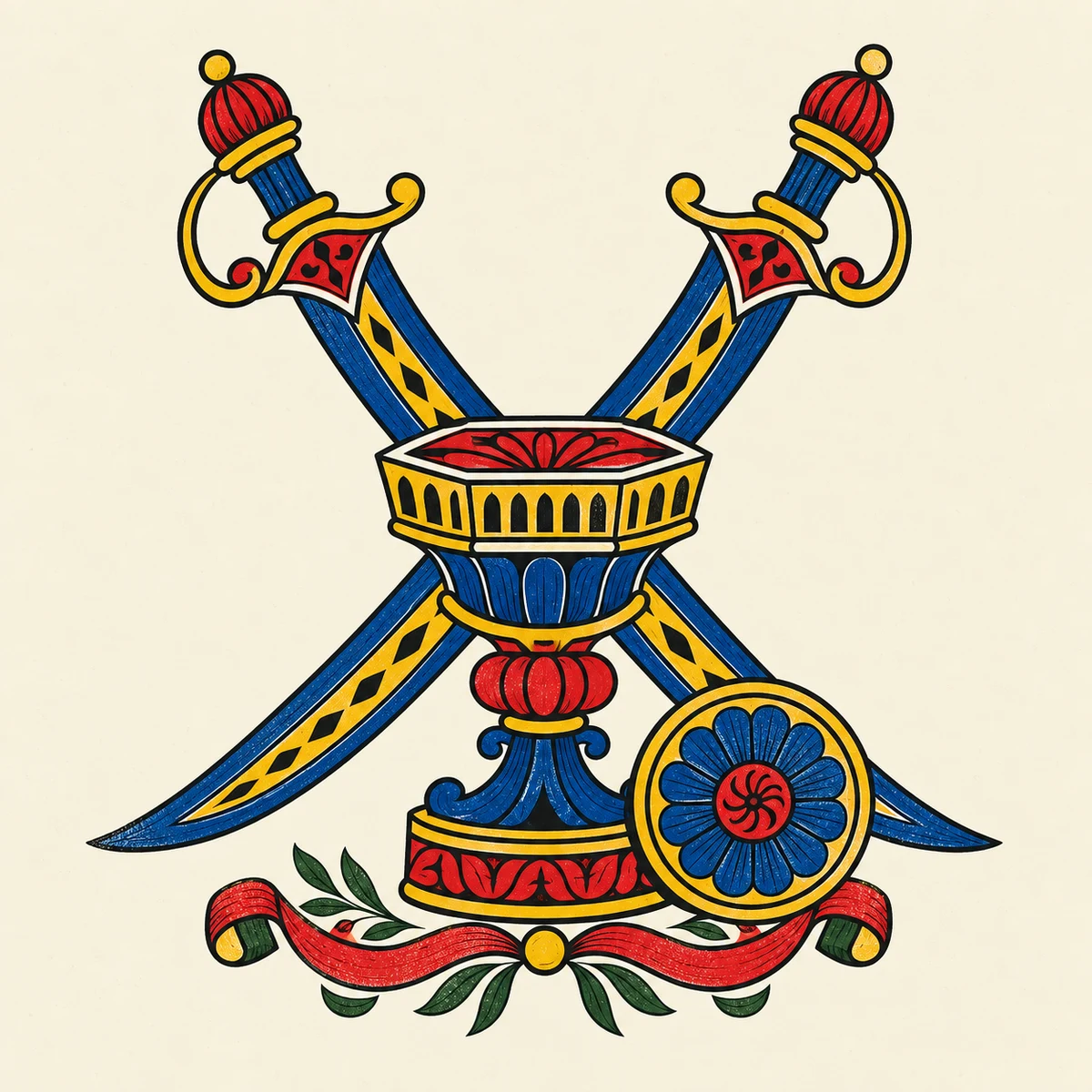
Swords, cups, and a floral coin.
The court cards tell you who they are. The aces offer advice.
On a Triestine deck, a label across a figure might read Fante di Coppe: the knave of cups. Around an Ace, you’ll find a saying about fortune, drinking, or the hazards of a game. The pictures have room for both ceremony and a little commentary.
Triestine is a regional playing-card pattern associated with Trieste. It belongs to the same wider world of cups, coins, swords, and batons as other Italian decks, but its long curved swords and elaborate cups give it a look of its own. A forty-card pack can also play Superjack with a simple rank-and-suit translation.
From Venice to Trieste
The pattern developed from Venetian cards. The International Playing-Card Society dates the emergence of a distinct Trieste pattern to about 1850, after cardmaking had grown in the city during the eighteenth century. Its central court labels are one of the identifying changes.
This is an Adriatic story, too. Triestine cards circulated beyond the city, including along the coast of the former Yugoslavia. The World of Playing Cards documents examples made for that market. Finding Italian-suited cards while traveling in Croatia makes more sense once you see that wider geography.

Curved swords and talking aces
Look at the swords in the bottom row. Their arcs cross and enclose spaces where the number can sit. The batons above them are long, patterned rods, unlike the knobbly wooden clubs of Napoletane cards.
The courts are mirrored, so you can recognize them either way up. On the photographed Ace of Swords: Il giuoco della spada a molti non aggrada. Roughly, “The game of the sword doesn’t please many.” The sayings vary by maker and edition; look at the Aces when you compare two packs. Pattern notes and examples.
For someone who first loved Magic: The Gathering for its illustrations and flavor text, this is a rewarding deck to examine. A small picture can have a voice even when the rules live somewhere else.
A short Triestine timeline
- Mid-1700s
- By about 1850
Triestine becomes distinct
Trieste’s cardmakers develop a distinct version of Venetian cards, including labels naming the courts.
IPCS · Triestine pattern - 1855 & 1857
- 20th century
An Adriatic deck
Documented editions include packs made in the former Yugoslavia.
World of Playing Cards · Regional examples
Read the ranks before you shuffle
A common forty-card Triestine deck is numbered 1–7, then 11, 12, and 13 in each suit. Those last three numbers identify the knave, knight, and king. They aren’t high-value gem cards. The IPCS pattern sheet also records older fifty-two-card versions; check which pack you have.
Dal Negro’s Triestine Extra is a forty-card pack. Games such as Briscola assign their own strength and scoring to those cards. Superjack does the same through the mapping below.
Use Triestine cards for Superjack
Each player needs a complete forty-card deck. Keep all its cards. If you have a fifty-two-card version, remove only the numbered 8, 9, and 10 pip cards from each suit, keeping the courts.
| Triestine suit | Superjack suit | Color |
|---|---|---|
| Coppe · Cups | Hearts ♥ | Red |
| Danari / Denari · Coins | Diamonds ♦ | Red |
| Spade · Swords | Spades ♠ | Black |
| Bastoni · Batons | Clubs ♣ | Black |
This is our agreed Superjack color key. Use the suit to determine color; the blue, red, and yellow decoration is artwork.
| Printed rank | Superjack role |
|---|---|
| 1 · Asso | Ace: costs 3 energy; choose its mode |
| 2–7 | Gems, keeping their numbers |
| 11 · Fante | Jack: costs 2 energy, starts at 1/1 |
| 12 · Cavallo | Queen: costs 4 energy, starts at 2/2 |
| 13 · Re | King: costs 5 energy, starts at 3/3 |
Pay creature costs with energy of the mapped color. A 12 of cups is your red Queen. She starts at 2/2: she deals two damage and takes two damage to kill. Pay her four-energy cost using the twos and threes of cups and coins, and those two red pairs equip her as a 4/4. Her printed twelve never becomes a cost or a combat statistic. How pairs and equipment work.
Begin at twenty health with five cards each and use the normal Superjack rules. For more on the deck itself, Wikipedia’s Italian playing cards is a useful next stop.
The forty cards already contain the whole game’s worth of ranks. Once you know the labels, you can get on with deciding what to play.