Briscola:
forty cards,
plenty of game.
The history, odd rankings, and beautiful decks of an Italian card game—and how those same cards can play Superjack, a battle game inspired by Magic: The Gathering.
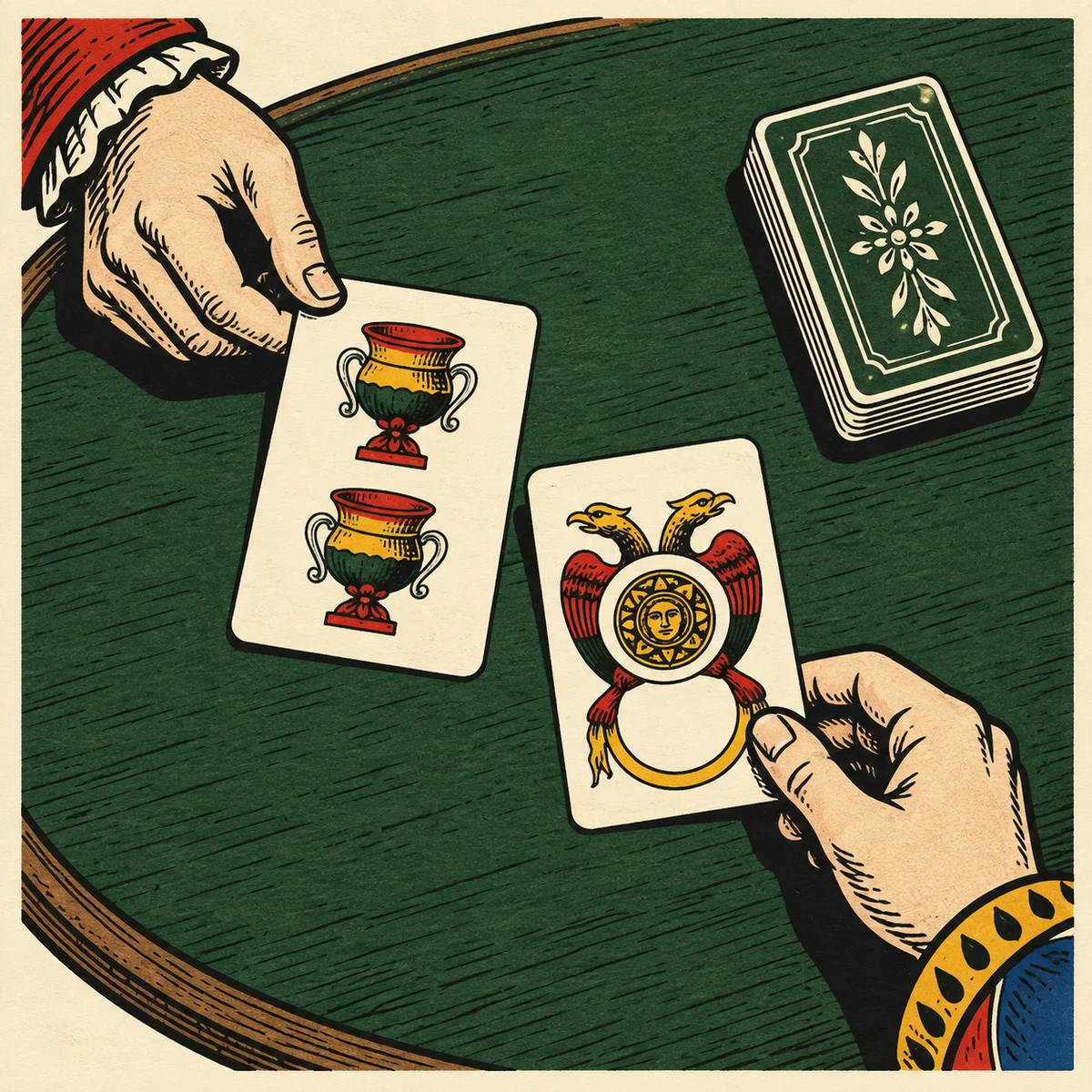
A two of cups meets an Ace of Coins.
In Briscola, a three outranks a king. Even a two of trumps can beat an ace from another suit. You soon learn to look twice before spending a good card.
Briscola is a game you can play with several different decks. Napoletane and Triestine are two of the regional card patterns used for it. The pictures change; the familiar forty-card structure stays. Pagat’s Briscola guide covers the game and its regional variations.
That distinction matters if you’ve brought home a pack and wondered what happened to the rest of the cards. A forty-card Italian deck may already be complete. It may also have everything you need for Superjack.
Where Briscola came from
Its exact beginnings are uncertain. Historians have connected it with French games including Brusquembille, although the route from one game to another is disputed. The Italian Wikipedia account, drawing on card-game histories, records a reference from 1828. That’s evidence of a game already being played, rather than a birthday we can confidently put on a box.
- 1828
Briscola appears in the record
An early reference gives the game a documented place in the nineteenth century. Its exact origins remain uncertain.
Italian Wikipedia · Historical references - 1847
A literary appearance
The game is mentioned in a poem by Giuseppe Gioachino Belli.
Italian Wikipedia · Historical references - 1888
A dedicated treatise
A nineteenth-century treatise records the game’s rules.
Italian Wikipedia · Historical references - A living tradition
Across the Adriatic
The game is also played as Briškula in coastal Slovenia and Croatia.
Pagat · Briscola and Briškula
Three cards in hand, one suit in charge
In the two-player game, deal three cards each from one shared deck. Turn the next card face up to name the trump suit, then place the remaining deck across it. Each player puts down one card; that little contest is a trick.
A trump beats any other suit. Otherwise, the highest card of the suit led wins. You may play any card in your hand, even when you could follow suit. The winner collects the trick, draws first, and leads next. After the stock runs out, play your remaining cards.
The unusual order is Ace, 3, King, Knight, Knave, 7, 6, 5, 4, 2. Aces score eleven points, threes ten, kings four, knights three, and knaves two. Everything else scores zero. There are 120 points: 61 wins; 60 each is a draw. Full rules and variants.
That freedom to play any card makes losing a trick a choice. You might let a worthless card go and save your trump for something worth taking. With only three cards in hand, every replacement deserves a look.
The artwork depends on the deck
Napoletane cards have upright, full-length court figures, straight swords, and chunky wooden clubs. Triestine cards have mirrored courts, curved swords, and sayings written around their aces. Both carry cups, coins, swords, and batons. Follow either guide to inspect the actual artwork and its history.
In the Superjack origin story, a deck bought for Eric in Croatia turned out to have forty cards. What first looked like an unfortunate purchase became a lovely discovery: a traditional deck already had the ranks the game needed.
Use a Briscola deck for Superjack
Bring two complete forty-card decks, one per player. Keep all forty cards in each. Agree on the following translation before shuffling; these red and black groups are our Superjack convention, regardless of the colors printed in the artwork.
| Italian suit | Superjack suit | Color |
|---|---|---|
| Coppe · Cups | Hearts ♥ | Red |
| Denari · Coins | Diamonds ♦ | Red |
| Spade · Swords | Spades ♠ | Black |
| Bastoni · Batons | Clubs ♣ | Black |
| Card in your deck | Use it as |
|---|---|
| 2–7 | Gems, keeping their numbers |
| Fante · Knave | Jack |
| Cavallo · Knight | Queen |
| Re · King | King |
| Asso · Ace, sometimes marked 1 | Ace |
This preserves Superjack’s 24 gems and 16 creature cards per player. Play by Superjack’s rules: twenty health, five cards in your opening hand, and one gem played per turn. Briscola’s trump suit and point values belong to Briscola. In Superjack, your three is a gem; its two-damage Fireball ability has nothing to do with the ten points it used to score.
If you arrived looking for Magic with standard playing cards, here’s the introduction to Superjack. Its creatures, equipment, and responses all work with this translation. The knight on your card gets to take the Queen’s job, horse and all.