We played
Magic
at lunch.
I learned Magic: The Gathering at a friend’s house around 1999. Years later, Eric and I started making a game of our own.
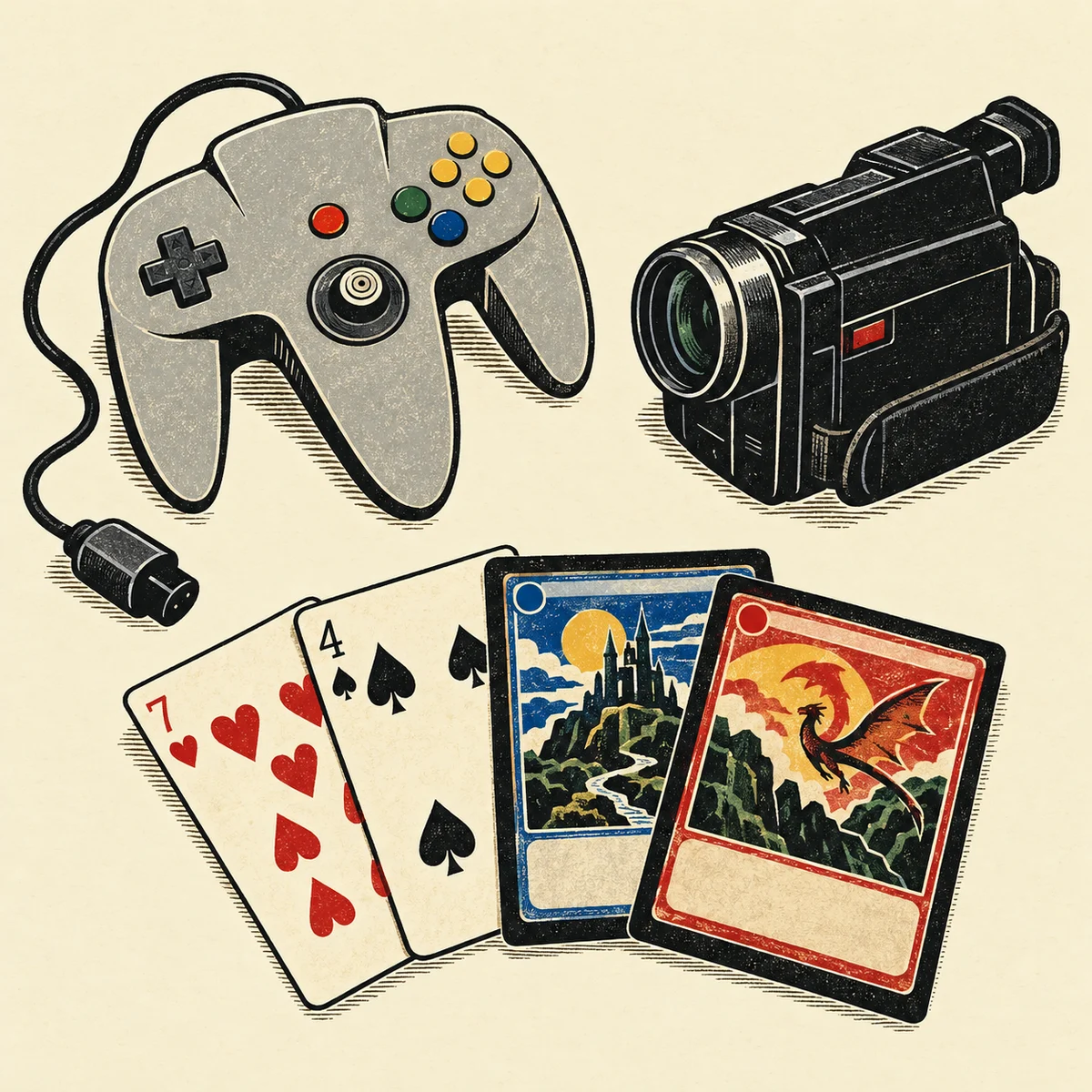
The games we grew up with.
The first thing I loved about Magic was the cards themselves.
It was around 1999, and I was spending a week with my buddy CJ in West Allis, Wisconsin. He had these cards with incredible artwork, descriptions, and little quotes on them. He told me they were Magic cards and showed me a bit of how to play. I thought they were awesome.
The next day, we got bored of playing Pokémon Snap on his Nintendo 64. CJ asked if I wanted to go to the game store to get some new Magic cards.
Of course I said yes. That was it. I was hooked.
When I got back to Palm Springs, I started showing all my best friends how to play: Eric, CJ—a different CJ—Max, Max’s little brother Tynan, and our buddy Brian. Soon we were playing every day.
Lunch in the library
Through seventh and eighth grade, we spent our lunches in the library playing Magic. We also played in the back of Ms. Geiger’s classroom. She was our friend Gabe’s mom, and she was cool with us using her back room as our Magic den.
We got obsessed. We played all the time, and we all talked about how cool it would be to have a Black Lotus.
Pokémon cards were around too. Mostly, we were trying to find a holographic Charizard. We didn’t play much of the actual Pokémon card game. Magic was the one we kept coming back to.
We also brought VHS-C camcorders to school and made homemade Jackass videos. We were wild kids. Not bad kids. Just wild.
Eric was part of that group. Years later, he would be the friend I made Superjack with.
Making a game with Eric
By then, Eric and I had spent years inventing games to play. We made a lot of them, most using standard playing cards. Eventually we started talking about an idea that brought us back to Magic: could we make a version of it with an ordinary deck?
We wanted the back-and-forth battles we loved in Magic, and we wanted to honor every pattern in poker. A deck already had pairs, straights, and four of a kind. Those combinations could matter, while the luck of the draw kept each game different.
There’s a bit of chess in Superjack, too. Each player has a separate deck with exactly the same cards. Both players start with the same set of tools, even though the shuffle gives you different hands.
That’s the combination I love: Magic, poker, and chess, all working together in an ordinary deck of cards. Getting it right took years.
We tested thousands of games. We found out which ideas worked, which were too heavy-handed, and which made the game harder to follow. Then we changed things and played again. The game gradually became its own thing, with its own decisions and combinations to learn.
One of the biggest improvements came from taking cards out.
Why we took out the 8s, 9s, and 10s
The number cards were our gems, and we wanted a better ratio of gems to creatures. That was the main reason we took out the 8s, 9s, and 10s: with fewer gems in the deck, you were more likely to draw a face card.
That left forty cards in each deck. Having fewer cards to keep track of also made the game easier to follow.
The deck I thought was missing cards
A couple of years later, I was traveling in Croatia and bought Eric a deck of cards. It’s something I do when I travel. I thought this one was a normal fifty-two-card deck, and I only bought the one.
Then I realized it had forty cards. At first, I was bummed out. I’d bought a gift without even realizing what kind of deck it was.
I looked it up online and learned that it was a deck used for Briscola. I started finding other traditional decks, including Napoletane and Triestine, with forty cards too.
They could work for Superjack, once you agreed on how their suits and court cards matched up with ours. The cards we needed were there. The deck I’d been disappointed by turned out to fit the game Eric and I had spent years making.
We’d arrived at forty cards by playing and testing. I’d had no idea how many people were already playing with decks that size.
A Google Doc, then a community
Eventually, Eric and I got the rules to a point where we felt ready to share them publicly. I put them in a Google Doc and pointed superjackthegame.com at it. For years, that was the website.
People started finding it. Superjack appeared in Pagat’s invented games directory and its list of combat card games. I posted it on Reddit, and people kept discovering it there over the years. When players asked for a Discord server, I made one.
Over time, the game has picked up a cult following. People who get into it tend to get really into it. After all those years of Eric and me working on the rules, it means a lot to see other people keep coming back to play.
Superjack: The Game has been part of my life for years. Eric and I went from playing Magic at lunch to making a game that other people now play with their friends. I still remember how excited I was when CJ first showed me his cards, and how much I wanted to show everyone back home.
Whether you’ve been following Superjack for years or just found it today, I’m honored to share it with you.