The court
has a few
tricks.
Aces, stacked Jacks, Rush, Trample, and Royal Sacrifice: what they do and when you can use them.
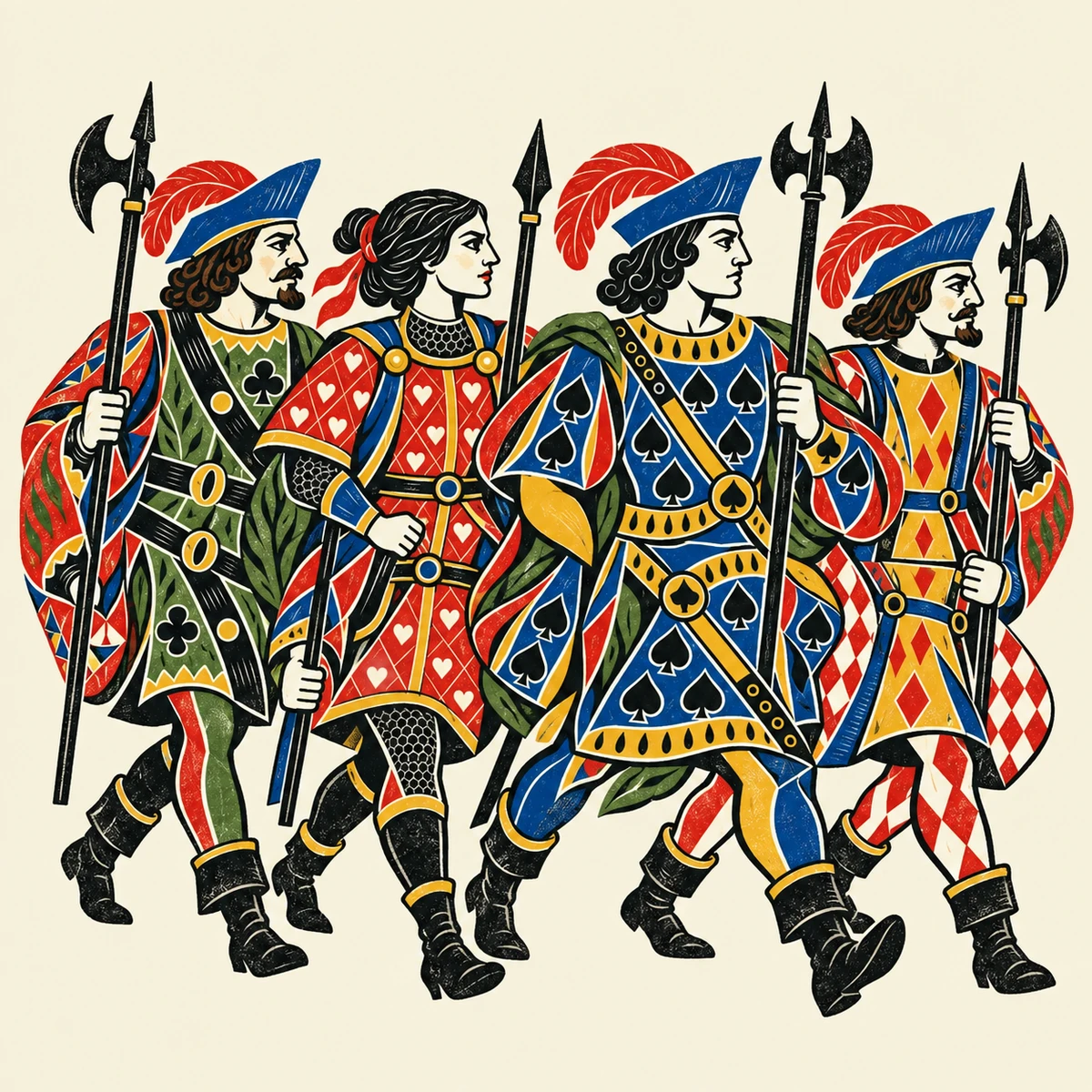
Four Jacks make one 8/8 Superjack.
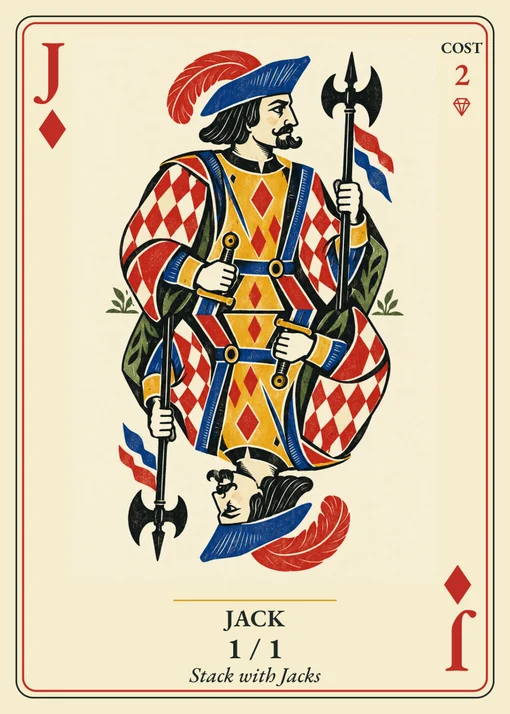
A Jack can join a stack, or help a Queen and King destroy another creature. Once you stack it, that second option is gone.
Knowing those options helps you read your opponent's table, too. A Jack beside a Queen and King of the same suit can threaten a creature much bigger than itself.
Aces can be played on either turn
An Ace costs three energy of its color. Each time you play one, choose: put it into play as a creature, destroy an opposing gem, or cancel another Ace before it takes effect.
You can play it whenever you have priority, the right to act. That includes your opponent's turn and combat. You still have to wait for a chance to act; you cannot interrupt a payment or undo damage already dealt.
Every Ace opens a response window: your opponent gets a chance to act before it takes effect. Another Ace can cancel it. A canceled Ace goes to the graveyard, the game's discard pile, and its energy cost is not refunded.
For a surprise blocker, play your Ace after your opponent declares attackers. Let it enter play, then assign it to block. Once blockers have been declared, it is too late to add another.
Rush lets new creatures attack
Rush lets a creature attack during the turn it enters play. An Ace played from your hand as a creature is a 1/1 with Rush. You still declare attackers during your own combat, and the creature must be upright, or untapped.
An Ace brought back from the graveyard by Gravedigger has no Rush. It must wait until your next turn to attack.
Royal Charge adds Rush and limits blockers
Pay a creature's entire cost by directly tapping gems with consecutive numbers, all matching its color, and it gets Royal Charge for that turn. This gives it Rush, and only creatures of the same rank can block it.
For example, tap a red 3–4–5–6 to pay a red Queen's four-energy cost. She can attack that turn, and only Queens can block her.
The gems must cover the exact cost. A Jack needs just two consecutive gems for Royal Charge. Energy already in your pool, including energy from Mine, does not count. Paying this way does not also activate the straight's ability.
Stack Jacks into one stronger creature
Jacks you already control can combine into one creature. Red and black can stack together. Each added Jack doubles the creature's power and toughness, before equipment bonuses:
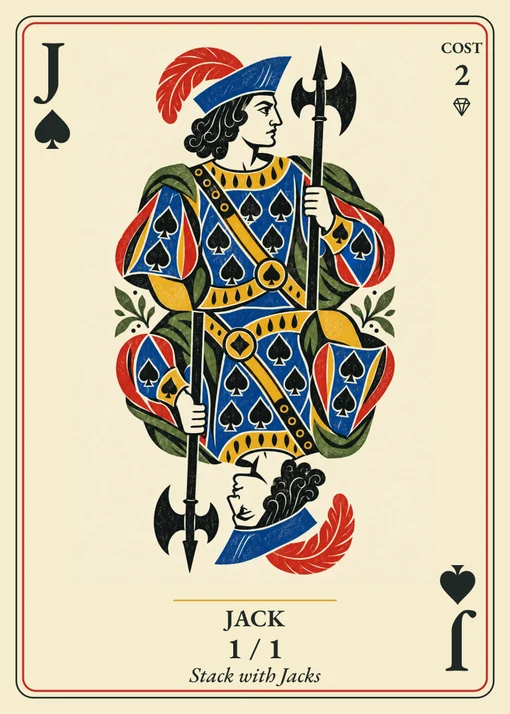
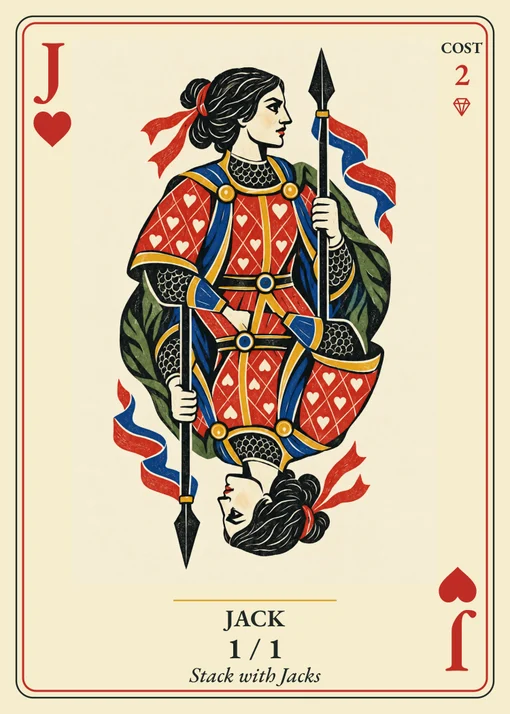
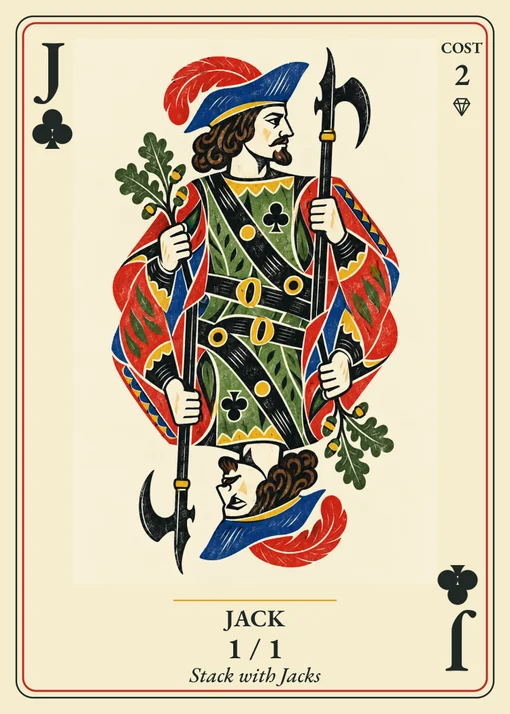
Numbers show power/toughness: damage dealt / damage needed to kill the creature. Equipment bonuses are added afterward.
The Jacks you add must be untapped. They can join an attacking Jack even though that attacker is tapped, or join a blocking Jack. The combined creature continues attacking or blocking. Once combined, the Jacks cannot split apart again. The whole stack still has just two equipment slots.
A stack is untrained if any of its Jacks entered play or changed control this turn. Without Rush, it must wait to attack. Add two or more Jacks to the same creature in one turn and it is also overencumbered: you cannot declare it as an attacker that turn. The starting Jack or stack does not count as an addition. A stack that was already attacking stays in combat if you enlarge it afterward.
If the stack dies, its Jacks go to the graveyard as separate cards. Gravedigger can bring back one of them.
Trample sends extra damage to the player
Four Jacks make an 8/8 Superjack with Trample. When it attacks, assign enough damage to kill its blockers; the excess hits the defending player.
A Superjack with no equipment deals eight damage. If an undamaged 3/3 King blocks it, three damage kills the King and five hits the player. If a Fireball has already dealt two damage to that King this turn, only one more is needed to kill him. Seven hits the player. With several blockers, first assign enough damage to kill all of them.
A blocked Superjack can still hit the player if its blockers are destroyed or removed before damage. An attacker without Trample cannot.
Royal Sacrifice destroys a creature
Royal Sacrifice needs a Jack, Queen, and King you control, all untapped and all of the same suit. J♥, Q♥, and K♥ qualify. A mix of hearts and diamonds does not.
Tap all three and sacrifice the Jack to destroy a target creature. The Queen and King stay in play tapped. The Jack must be a single, unstacked Jack, but none of the three needs to be trained.
You can use Royal Sacrifice on either player's turn when you have priority. Your opponent gets a response window before the target is destroyed. Equipment will not save it: the ability destroys a creature regardless of its toughness.
Before you stack a Jack, check your Queen and King. You may already have the three cards for Royal Sacrifice.