Before
the move
lands.
Your opponent plays an Ace. You still have a say. Response windows in Superjack, explained through one small exchange.
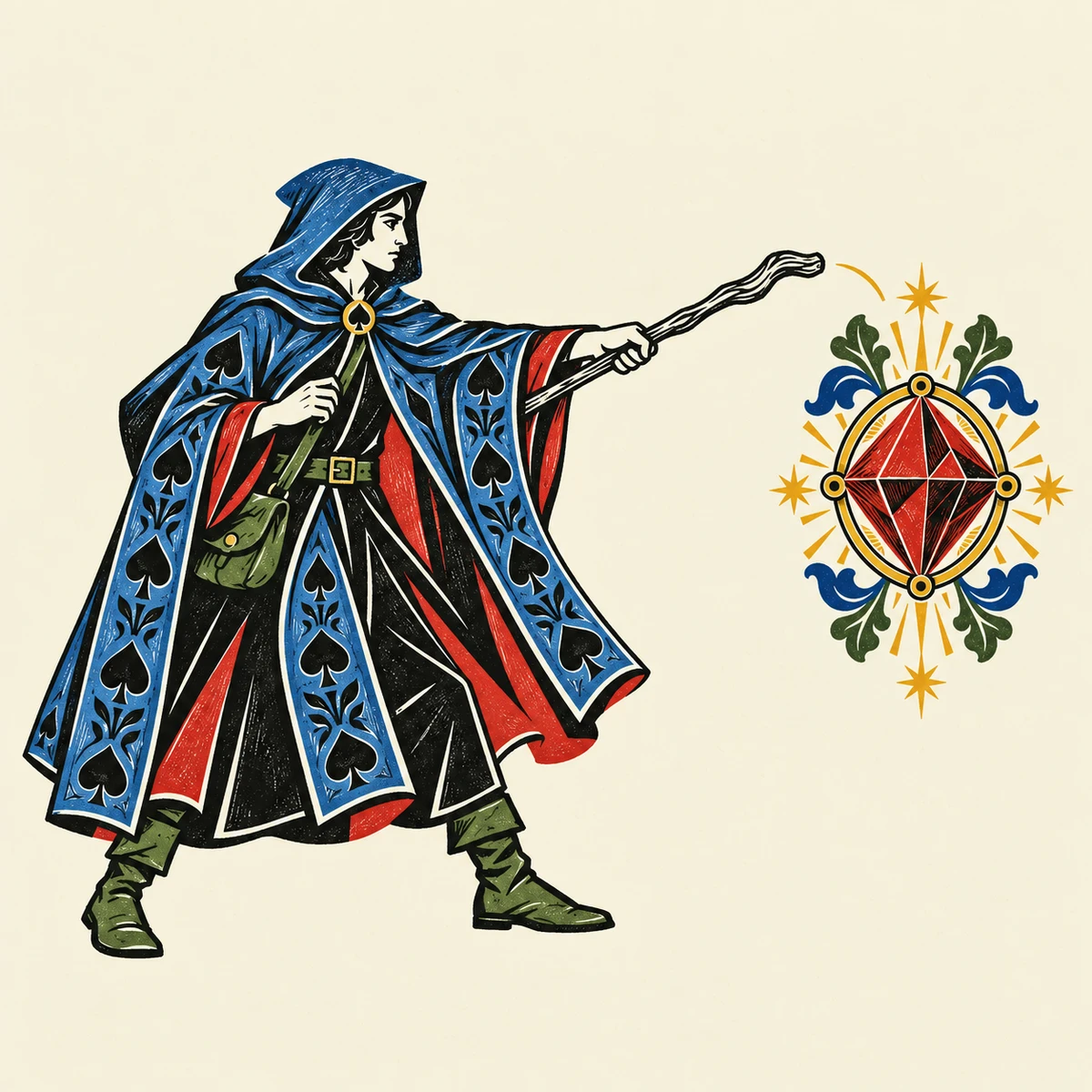
An Ace opens a chance to respond.
Your opponent plays an Ace to destroy your six. You reach for the six.
The gem is still upright, or untapped, and a six can be sacrificed to draw a card. You have a chance to do that before the Ace's effect happens.
That chance to act before an effect happens is a response window.
Priority: who gets to act?
Superjack calls the right to act priority. During your main phases—the parts of your turn before and after combat—you keep it while playing gems, summoning Jacks, Queens, and Kings, or equipping pairs. Your opponent gets a chance when you open a response window or pass.
Aces, gem sacrifices, straights, equipping pairs, stacking Jacks, and Royal Sacrifice are reactive actions. You may use them on either player's turn when you have priority.
Playing your one gem is reactive too, but only on your own turn. Jacks, Queens, and Kings must be played in your main phase, with no effects waiting to happen.
Which plays open a response window?
Four plays do: any Ace, Fireball, Royal Sacrifice, and Mind Control. You make the play and pay its cost, then your opponent gets priority before the effect happens. Even an Ace played as a creature opens a window.
Carrying out an effect's instructions is called resolving it. The response window gives your opponent a chance to act before that happens.
Sacrifice the gem before the Ace destroys it
Your opponent pays three energy of the Ace's color and names your untapped six as its target. The Ace's effect waits. You now have priority.
You turn the six sideways to tap it, then sacrifice it: put it in your graveyard, the game's discard pile. Draw happens immediately, so you draw a card while the Ace is still waiting.
If you both pass without taking another action, the Ace resolves. The six is already gone, so it destroys nothing. The Ace goes to its owner's graveyard, and its energy cost is not refunded.
The Ace targets your six.
Your opponent pays three energy to play an Ace that would destroy your untapped six. You get a chance to act before that happens.
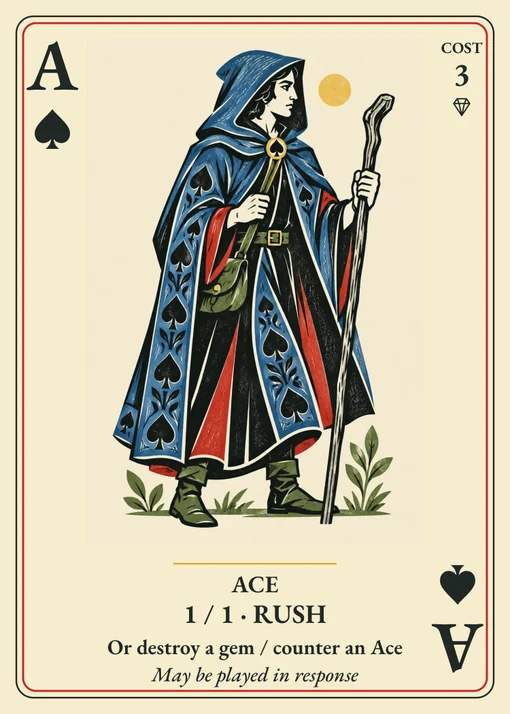 Waiting to resolve
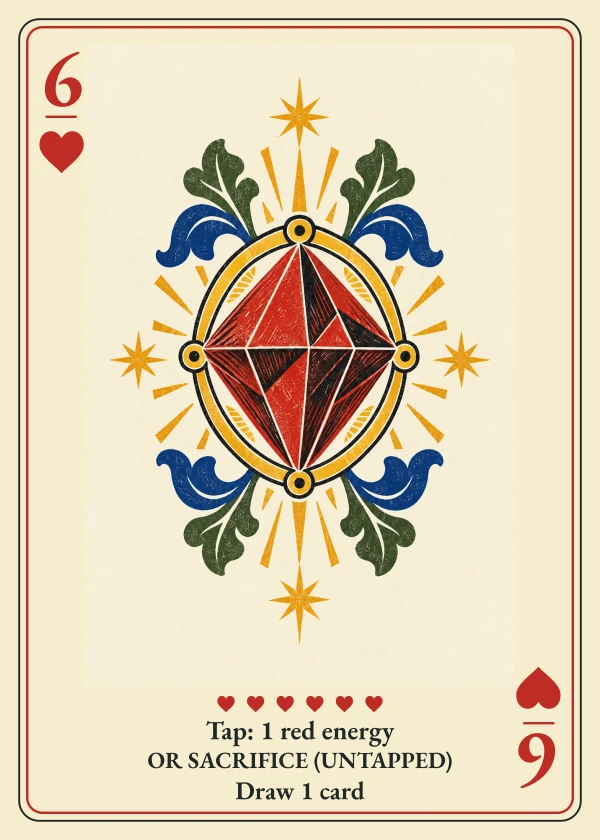 Upright · Untapped
Sacrifice the six to draw a card.
Tap the six and put it in your graveyard. Draw a card immediately. The Ace is still waiting.
Still waitingIn your graveyardThe Ace has nothing left to destroy.
After both players pass, the Ace resolves. The six is already gone. The Ace goes to its owner’s graveyard; its three energy are not refunded.
To the graveyardAlready sacrificedYou still lost the gem, but you got a card out of it. Had the six already been tapped, you could not have sacrificed it for Draw.
Resolve the newest effect first
Some responses open another window. Suppose you answer an Ace with an Ace of your own, choosing Counter-Ace. Your opponent can answer that too, if they have a legal play and can pay for it.
Waiting effects resolve newest first, one at a time. When both players pass in a row, the newest effect resolves. Then you get another chance to act before the next one. If your Counter-Ace resolves, it cancels the Ace it targeted. Counter-Ace can only cancel Aces, so it cannot stop a Fireball.
Which actions happen immediately?
Tapping for energy, Mine, Draw, Plus One, Research, Gravedigger, equipping, stacking Jacks, and playing a gem all happen immediately. They do not open a response window. That is why you drew your card before the Ace could destroy your six.
You still need priority to use these actions. Once a player starts tapping gems to pay, the other player cannot interrupt that payment.
Responding before combat damage
After attackers are declared, the defender can act before choosing blockers. This is when an Ace can enter play as a creature and then block. Once blockers are assigned, the attacker gets priority first. Both players can use reactive actions before damage.
With no effects waiting, both players passing in a row lets combat proceed to damage. If either player takes an action, both must pass again.
Passing gives your opponent the chance to act. At the end of the turn, you both get that chance before two passes in a row finish the turn.
At a physical table, name your play and wait for an answer. “Ace on your six” is enough. Give your opponent a chance to use the gem before you destroy it.