The Goblin King
gets a
rules box.
Magic’s next Secret Lair drops put Labyrinth, KPop Demon Hunters and Marvel: Zombies on familiar cards. The fun is in the casting.
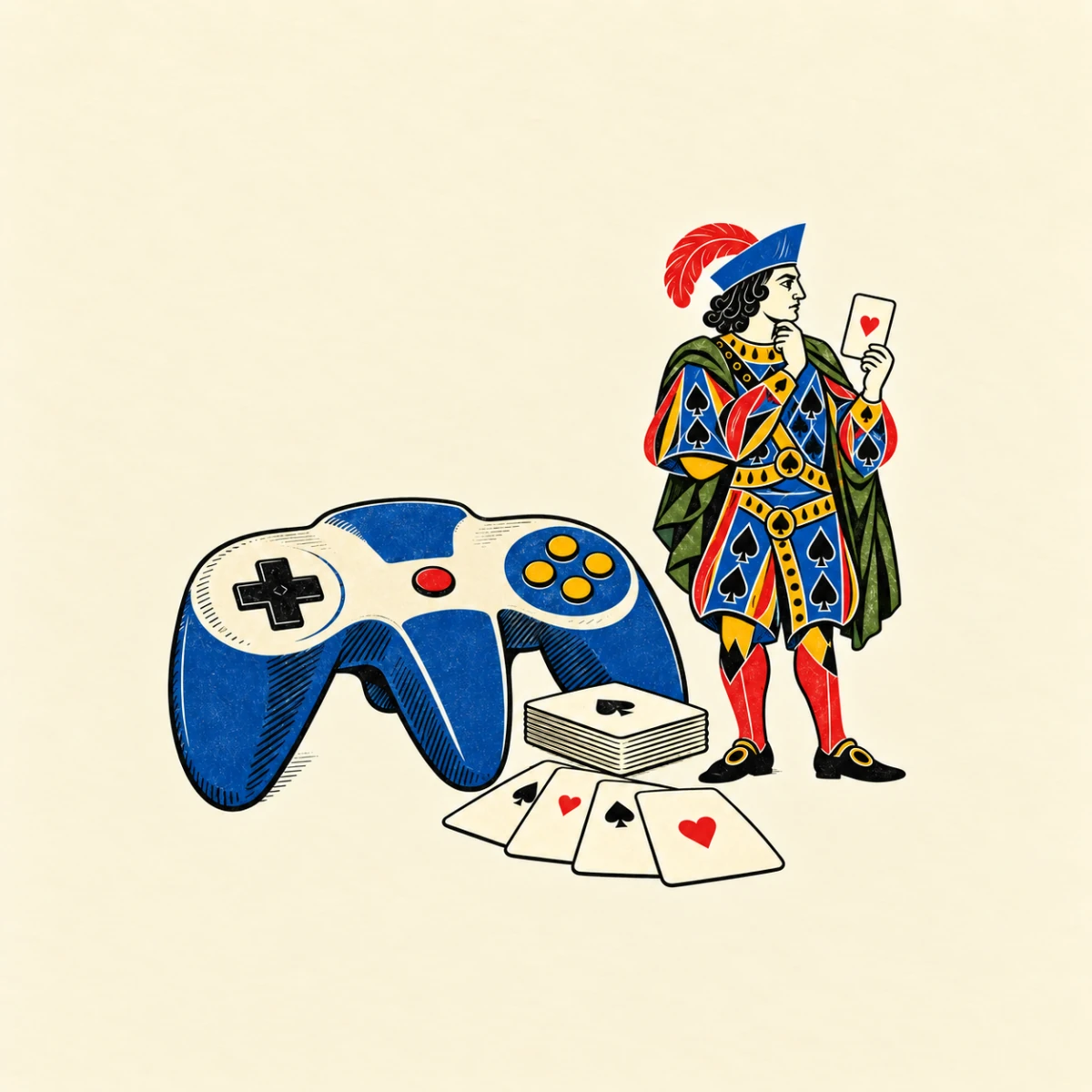
A controller, some cards, and another game to discover.
CJ and I had gotten bored of Pokémon Snap. He asked if I wanted to go to the game store for more Magic cards.
This was around 1999, during a week I spent at his place in West Allis, Wisconsin. He’d shown me Magic the day before. I liked the artwork, the descriptions, the little quotes on the cards. I wanted to see more of them.
I thought about that trip when Wizards announced its Corn Maze Superdrop. The lineup includes three Jim Henson’s Labyrinth drops, KPop Demon Hunters: How It’s Done, and Marvel: Zombies. Sales are scheduled to begin October 12, 2026. As of October 1, the drops are announced and still upcoming.
One of the characters is Jareth, the Goblin King played by David Bowie in Jim Henson’s 1986 film Labyrinth. His Magic card is a new treatment of Muxus, Goblin Grandee, an existing card. When Muxus enters play, he checks the top six cards of the deck and brings in the Goblin creatures with mana value five or less. A Goblin King arriving with more goblins is a pretty good bit of casting, even if you’re meeting him for the first time.
Muxus also gets stronger when it attacks for each other goblin its controller has in play. Put Jareth in that role and the rules do some of the acting. The card gives him a way to behave like the character people came to see. Someone who knows the film can recognize him; someone who knows the game can start thinking about which goblins belong in the deck.
For card players, a crossover has a casting decision to argue about, followed by a game decision to make. Jareth can be a good fit for Muxus while Muxus is a poor fit for a deck short on goblins. The picture establishes the role; the other cards have to make it work.
Years later, Eric and I were making games with ordinary playing cards. Eventually we came back to a question from our years of playing Magic together: how much of a creature battle could fit into a standard deck? We wanted the battles we loved and the combinations already sitting in a deck of cards. Superjack grew out of that.
A standard deck comes with a cast already. Jacks, Queens and Kings look ready to fight. Number cards look useful in quantity. An Ace is the card people expect to cause trouble. Superjack gives those expectations rules, then lets the cards combine in ways their usual ranks do not suggest.
Each player takes a separate deck and removes the eights, nines, tens and jokers. That leaves forty cards apiece. The twos through sevens are gems that supply energy; Jacks, Queens, Kings and Aces can become creatures. Both players start with the same card pool and twenty health, trying to bring the other player to zero.
The court starts small. A Jack costs two energy and is a 1/1. A Queen costs four and is a 2/2; a King costs five and is a 3/3. Those two numbers are power and toughness: how much damage a creature deals, and how much damage kills it. The printed rank gives a newcomer a reasonable first guess about the creature.
Then the Jacks complicate that guess. Two can stack into a single 2/2. Three become a 4/4, with higher base stats than a King. All four form an 8/8 Superjack with Trample, sending excess combat damage past its blockers to the defending player. The lowest court rank has a route to becoming the largest creature.
Stacking takes a little planning. Only untapped Jacks can stack, red and black Jacks can combine, and a stack cannot come apart again. A stack containing a Jack played this turn cannot normally attack yet; adding two or more Jacks to the same stack in one turn also prevents it from being declared as an attacker that turn. The rules cover those details. Four cards make a serious threat, but assembling them takes some care.
The Ace has a different job. For three energy of its color, it can enter as a 1/1 creature with Rush, destroy an opposing gem, or cancel another Ace before it resolves. Rush lets the creature attack immediately. An Ace can be played during an opponent’s turn, including combat. Held back in hand, it can therefore become a blocker after an attack has been declared. Its small creature stats tell only part of the story.
Those roles work with ordinary playing cards. Illustrated Superjack editions add their own artwork and reminders; the game uses the same rules. An opponent still has to account for the Jacks already in play and the Ace that might be waiting in hand.
There is plenty to recognize in the new Secret Lair artwork if you love those characters. There is also something for a player coming to the characters for the first time: a Goblin King who gathers goblins is easy enough to follow. I came to Magic wanting to see more of the cards. When Eric and I made Superjack, we found more to do with cards we already knew. I still like that an ordinary Jack has three companions somewhere in the deck, and a very good reason to find them.